Walking Arimatsu: Nagoya's 400-Year-Old Shibori Town
 toshizou_guide
Just about twenty minutes by train from the center of Nagoya, you step off at a small station called Arimatsu — and there it is, a town that has been dyeing cloth for four hundred years.
What makes this place special isn't the color of the dye. It's the way they tie the cloth. Some craftspeople and artists come all the way from abroad just to learn that technique.
This time, I want to leave a written record of a slow walk through Arimatsu — filling in a few things I couldn't quite fit into the video.
Off the Train, Onto the Old Tōkaidō
Step out through the ticket gate at Arimatsu Station and there's a large map right away, with English on it too — a kind gesture for visitors from overseas.
The town is a short walk from the station. You come out onto a single road that curves gently. This was once the Tōkaidō — the highway connecting Edo and Kyoto, the most important road in old Japan. Arimatsu was a town built along it.
The first thing you notice as you start walking is that there are no power poles, no wires. The sky feels wide. Beneath it stand rows of old merchant houses where shibori was once sold. I take it slow, looking at them one house at a time.
Eaves, Lattices, Windows — The Details of a Merchant House
Look closely at the houses and you start to see all the little tricks built into them.
First, the eaves are very deep. This, they say, was a way to keep the dyed cloth out of the harsh sun.
On the ground floor, thin wooden bars stand in a row — a lattice called renji-gōshi. Hard to see in from the street, yet easy to watch the street from within. A sensible design, the kind only a town of merchants would come up with.
Look up to the second floor and you'll find a small latticed window. It's called a mushiko-mado.
And under the eaves of one house, an old gas lamp still remained. From the Meiji era, I'm told.
The walls are thick, packed hard with plaster — a structure called nurigome-zukuri, built to protect the house from fire. To people of the Edo period, fire was a very real danger. The wisdom of merchants who feared it above all else is written into the town, here and there.
The Building That Holds the Float
Walking along the street, you come upon one especially large building. Inside it sits a magnificent festival float — a dashi. Sadly, I couldn't see it today. At the autumn festival, they say, this great cart is pulled all through the town.
This town was born more than four hundred years ago, a small settlement built along the Tōkaidō. The land was poor for farming, so people looked for other work. And what they found was the craft of tying cloth to make patterns — shibori. Travelers bought it here and carried it home as a souvenir.
That, the town will tell you, is how Arimatsu's shibori began.
To the Shibori Hall — What Is Shibori, Really?
So what is this shibori, really? I step into the Arimatsu-Narumi Shibori Hall in the middle of town.
The ground floor is a shop selling shibori goods; the second floor is a small museum of historical materials. You can even watch a craftsman at work up close.
When you hear "Arimatsu shibori," many people first picture the color indigo. Lately that indigo is sometimes called "Japan Blue." But what's truly remarkable about this town isn't the color — it's the way the cloth is tied.
The idea itself is very simple. You bind plain white cloth with thread, dye it, and then untie it. Only the bound parts stay undyed, and that becomes the pattern. That's all.
And yet the ways of tying are astonishingly varied. Arashi, miura, sekka, te-gumo, mokume, maki-age, kanoko… At its peak, the count passed a hundred techniques.
It was this richness of technique that turned the world's eyes toward Arimatsu. In 1992, Arimatsu became the town that held the very first International Shibori Symposium. By now, the word "shibori" has become one the whole world understands.
Watching the Handwork
I'm shown how the cloth is actually tied. With thread, one point at a time, the fabric is bound. The way it's tied is what decides the pattern.
Even with the same technique, no two patterns are ever exactly alike — because it's all done by hand. Even the same method turns out differently depending on the person. Each single piece carries something of the character of the one who tied it. So the craftsman I spoke with told me.
There are makers and artists, he said, who come all the way from abroad just to learn this way of tying.
These days, dyeing with real indigo has become rather rare. Natural indigo is expensive, and most cloth now is dyed with chemical dyes. And yet the handwork of tying the cloth hasn't changed in four hundred years.
By the way — natural indigo dyes slowly, while chemical dye takes fast and deep. And you could see that difference in the finished cloth — that was fascinating too.
I was also shown a piece of cloth all tied up. It's far stiffer than it looks. Binding it that tightly is how they make sure the dye never reaches those parts.
The Armor, and the Battlefield Nearby
Inside the hall, there was also a suit of armor. They say it was dyed using shibori, too.
Here, let me make one correction to the video. In it, I called the old battlefield nearby "Sekigahara" — and that was a mistake. What lies just beside Arimatsu is the site of the Battle of Okehazama of 1560, where Oda Nobunaga defeated Imagawa Yoshimoto. Sekigahara is in Gifu Prefecture, far from here. My apologies, and here is the correction.
The Okehazama battlefield is within walking distance of Arimatsu, and it makes a fine addition to a walk through town.
Suzusan — Carried On, and Out into the World
On the ground floor of the Shibori Hall, shibori goods are actually for sale.
Along the street there's also a shop called Suzusan. The owner is himself a shibori craftsman. Inside you can buy shibori products, the tools, even books about shibori.
When I visited, the shop was under renovation and operating out of a temporary space. Even so, it had a lovely feel to it. They hold workshops here too, and makers and artists come from abroad to learn.
I bought one piece myself — a tenugui, a small hand towel. Father's Day was coming up, so it was for my own father. Maybe it was a little too expensive for him.
To Close — Arimatsu Tenmansha
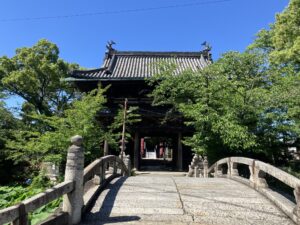
One last place. On the edge of town there's a small shrine: Arimatsu Tenmansha, a place that has watched over this town for a very long time.
To reach it, a long stone stairway was waiting. Banners swaying in the wind, I climbed it step by step. At last, the main hall.
It was quite a climb. I'd assumed no one would bother coming all the way up here — and yet plenty of people did. A shrine cherished by the locals, I suppose.
I put my hands together and gave my thanks for being able to film here today without trouble. This, too, was a beautiful place. If you've come this far, do climb up and see it.
Twenty Minutes from Nagoya, Where a Different Time Flows
Just twenty minutes from Nagoya. And yet a different kind of time flows through this town.
It isn't a flashy tourist spot. Even so, Arimatsu has something you won't find anywhere else. It's a town worth visiting, I think.
This article is a written reworking of my YouTube video "(video title)." I'd be glad if you watched the video as well.
\ Get the latest news /